
Every year, Van Dam publishes a Year in Review magazine for clients and friends — a printed look inside the boats, the people, and the ideas that defined the previous twelve months. The 2023 edition covers a year of serious R&D: a wooden boat build that required inventing technology from scratch, an in-house bilge system designed and 3D-printed on campus, running gear engineered through computational fluid dynamics, and a team that kept raising its own bar in every direction.
You can flip through the full 2023 Van Dam Magazine below, or scroll down for the written highlights.
View the 2023 Van Dam Magazine →
Most boatbuilders build boats.
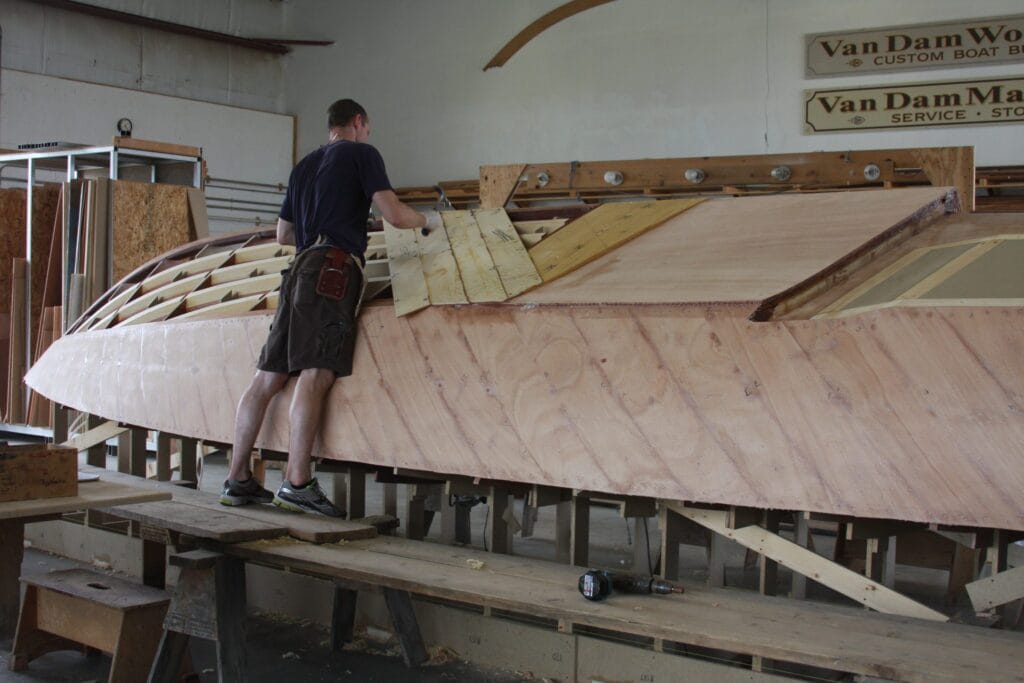
Van Dam does that — but in 2023, the shop in Boyne City, Michigan also functioned as a laboratory. While Hull #63, the most technically ambitious wooden boat the company had ever undertaken, took shape on the floor, the team around it was inventing things. A new bilge management system, designed and 3D-printed in-house. Wake-adaptive running gear developed through Computational Fluid Dynamics. Custom navigation lights that didn’t exist anywhere before Van Dam built them. A digital switching architecture that makes a custom wooden boat operate more like a modern car than a piece of marine equipment.
2023 was also a year of people. A master craftsman who reached 30 years. An apprentice who reached graduation after five. Six Van Dam boats at an international boat show, all scoring platinum. And a team that kept building, kept learning, and kept getting better at a craft that most of the world has already forgotten how to do.
Here’s the full picture.

Where Van Dam’s Wood Comes From
The most common question visitors ask when they walk into the Van Dam shop: what kind of wood are your boats made of?
The answer is Sipo — more precisely called Utile, an African hardwood. For many years, Van Dam’s boats were built from Honduran Mahogany, the traditional choice for fine wooden boat construction. When Honduran Mahogany became heavily regulated due to its endangered status, Van Dam needed a species that matched it in the ways that matter: grain structure, color, chatoyancy, and structural strength. Sipo is that species.

The journey a single log takes before it becomes a Van Dam plank covers three continents. US-based consultants travel regularly to Africa to evaluate standing trees in person. Once a tree passes inspection and is harvested, it makes its way to Germany or the Netherlands for rough milling, then onto a container ship that sails across the Atlantic, through the Panama Canal, and up to the Port of Seattle.
Ben Van Dam personally inspects every log at the port before it’s cleared for the shop. If it passes, it’s precisely labeled, stacked, and trucked to Boyne City. Each log is stored so the boards can be reassembled in milling order — allowing Van Dam to book-match the entire boat, laying planks so each one is a mirror image of its neighbor. Generally, one log builds 2 to 3 boats. By the time the wood touches the shop floor, it has visited three continents.
5-star: Taking Customization to Another Level
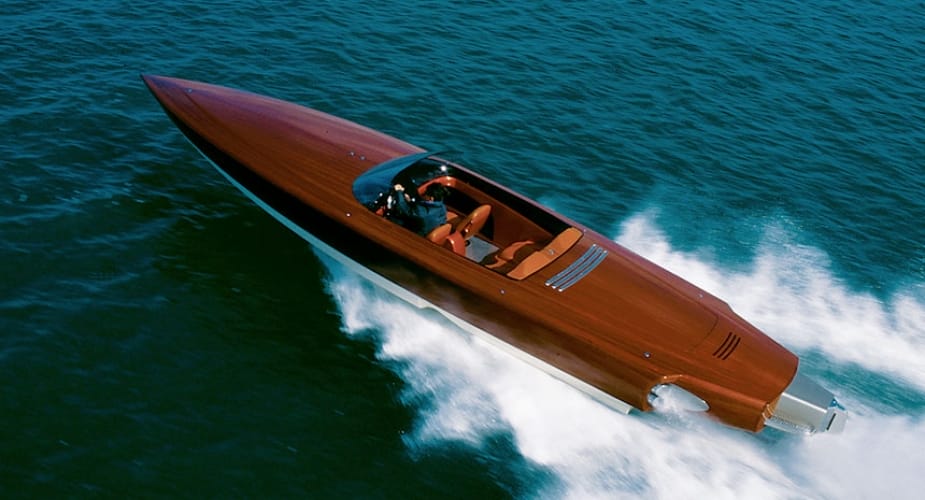
The centerpiece of 2023 was 5-Star — a 30-foot custom wooden runabout that dominated the year and was scheduled for Spring 2024 launch.
The mission, as Van Dam framed it: take customization to another level. The build features custom patterns on the bottom paint, engraving throughout the custom metal components, an extraordinary level of woodworking, and a technology stack that no comparable production boat could match. Every system on the boat was either specified to an unusually demanding standard or designed and built by the Van Dam team from scratch.

The Navigation Light That Had Never Been Made
One of the clearest examples of what 5-Star demanded from the team came early in the build, when the question of navigation lighting was raised.
The goal, as described by project manager and master craftsman Chad: create a navigation light housing that integrated seamlessly with the hull — transforming into a decorative piece of art even when not in use — while meeting all Coast Guard visibility requirements. No available product could do this. The housing would have to be designed and built from scratch.
Van Dam’s team modeled the housing in CAD software directly within the hull geometry, blending it into the massive cutwater at the bow. The complex housing was then milled from a 316 stainless steel billet. A specialist contractor was selected to design and build a custom LED board to fit within the housing — engineered to meet the Coast Guard’s two-nautical-mile visibility requirement, while also managing the cutoff angles required when integrating a high-powered light into a three-dimensional curved surface.
The result, in Chad’s words, stands as an absolute masterpiece.
Wake-Adaptive Running Gear: 40% Less Drag
Below the waterline, the engineering challenge on 5-Star was just as demanding.
Van Dam engaged Brant Savander, Ph.D., P.E. — a naval architect and Ben Van Dam’s former University of Michigan professor — and his firm Maritime Research Associates to develop a wake-adaptive running gear system covering the shaft log, strut, propeller, and rudder. The result: a 40% reduction in appendage drag, with dramatic reductions in noise and vibration.
The principle behind it: every component in the water is exposed to the wake from something upstream. The propeller generates a swirling wake. Traditional rudder design ignores that swirl; wake-adaptive design orients each rudder section to the actual flow it will receive, allowing the rudder to generate a small forward lift component that reduces drag rather than accepting it passively. Modern Computational Fluid Dynamics software allows Savander to extend this logic to the entire running gear system — hundreds of iterations converging to the optimal solution for this specific hull.
The Van Dam team’s summary: fast is quiet, and quiet is fast.

The Mechanisms: Engineering the Invisible
Once the structural envelope of 5-Star was determined, Van Dam marine designer Tim turned his attention to what lives inside it. Mechanisms — powered by electricity, hydraulics, or spring action — are how Van Dam uses every inch of space and removes every moment of friction between owner and experience.
5-Star’s mechanism list includes mechanized engine hatches operated by linear actuators, custom deck cleats and fender hangers designed to pop up when needed and stow flush when not, cockpit side tables that appear at the push of a button, and a companionway entry coordinated by three separate mechanisms working in precise sequence. Each exists for a specific reason. None of them announce themselves.

Digital Switching: A Wooden Boat That Runs Like a Modern Car
The electrical architecture on 5-Star represents a significant departure from how boat systems have traditionally been managed. Rather than running large supply cables from a central panel to every individual load, Van Dam’s digital switching system places intelligent modules throughout the hull, connected via NMEA network cables to a programmable interface at the helm.
The practical results go well beyond convenience. Lighting with programmable timers and dimming. Soft-start capability for motors and actuators. Alarms and run counters on bilge pumps. FOB-accessed engine control with integrated man-overboard capability. User-specified run scenarios. All of it visible and controllable from the helm in real time.
Thor, Van Dam master craftsman and ABYC Master Technician, designed and documented the system. His framing: the goal is a boat that operates as intuitively as a modern car. One button, and everything just works.
The physical switch panel the operator touches was designed and machined in-house by Jesse, master craftsman and Metal Shop Manager — each button face milled from 316 stainless steel using solid carbide end mills as small as 1/32 inch in diameter, then laser-labeled to a marine-grade finish. A functional work of art.
Nothing to Fear From Complexity
The old-timer’s critique of modern boat technology: every extra wire is another failure point. Keep it simple.
Thor, writing his 2023 editorial for the Van Dam magazine, is sympathetic to the instinct — and thinks the conclusion is wrong. His argument: the marine industry hasn’t just grown in the last few decades, it has matured. A tightly competitive marketplace combined with rigorous standards organizations (USCG, ABYC, NMMA, NMEA, ISO, CE) means that modern technological marvels are generally robust, thoroughly tested, and well supported. GPS-enabled maneuvering controls, doppler radar threat assessment, satellite weather overlaid on chart plotters, nearly autonomous generators — these aren’t experimental features anymore. They’re reliable tools.
For the people building custom wooden boats, this maturation is good news. The tools available today for a bespoke commission are genuinely extraordinary. And, Thor notes, the rate of advancement is increasing. A fascinating age, indeed.

DryBilge and the 3D Printer: Two In-House Innovations
Van Dam’s R&D program works like this: a problem presents itself, the team tries to solve it better than anything currently available, and a product or process emerges.
In 2023, two significant innovations came out of this process.
The DryBilge system addresses a problem every boat owner knows: the nuisance water that standard bilge pumps can’t quite reach. Commercial solutions exist, but Van Dam found them clunky in operation and aesthetically unrefined. Thor designed a solution from scratch. The Van Dam DryBilge uses a small diaphragm pump drawing water through a valved manifold from pickups at the bilge low points. The manifold and valve body are designed and 3D-printed in-house at Van Dam. Each zone includes a miniature water sensor, enabling on-demand pumping rather than timer-based operation. Control runs through the boat’s digital switching system. The DryBilge is out of R&D and available for installation.
The Formlabs Stereolithography 3D printer, acquired in 2022 and fully integrated into the workflow in 2023, changed how Van Dam prototypes everything. The custom throttle and shifter housings for Hull #63 are a clear example: the design team sketched multiple variations, the printer produced physical versions of each, the owner evaluated them in hand, and the final design was then machined in stainless steel on the Haas CNC. Printed part to production part — without a single expensive iteration on the CNC.

Paint & Varnish: The Department That Protects a Wooden Boat’s Value
Ask anyone at Van Dam which department is most responsible for the boats holding their value over time, and the answer is consistent: Paint & Varnish.
The P&V team functions as what Van Dam calls the primary care physicians for every boat in the portfolio. Their annual inspections cover dings, dents, damage, structural issues, and finish degradation — catching problems early, before they compound. They also do quality control checks during the build process itself, evaluating raw wood parts for finish readiness before a brush touches anything.
The finishes they use range from traditional spar varnishes applied with badger hair brushes to high-tech two-part catalyzed systems requiring precise temperature, humidity, and mixing ratio monitoring. Many of their finishes are the same products used on Rolls Royce automobiles.
In 2023, the P&V team worked on 40 boats from across the country — the most in any previous year — including full exterior refinishing on three Van Dam classics: Lekkerbekkie (2013), Lady Anne (2002), and Impshi II (2001). Guiding the department is Trevor, who marked 30 years with Van Dam in 2023. His institutional knowledge of the specific needs of each boat in the portfolio is, like everything else at Van Dam, irreplaceable.

The People: Six Platinums, 14 Certifications, and One Graduation
In September 2023, the Antique & Classic Boat Society held its International Boat Show at Bay Harbor Marina — Van Dam’s backyard. Van Dam entered six boats: Adieu, Lightning Strikes, Chiara, Catnip, Italmas, and Dreamboat. All six scored Platinum in the Contemporary category — the highest level awarded by the ACBS. Van Dam also hosted the Friday evening scholarship dinner, a sold-out fundraiser supporting students pursuing wooden boatbuilding education.
Away from the show, the team continued building its technical credentials. In 2023, the Van Dam campus earned 14 new ABYC certifications in Marine Electrical, Marine Corrosion, and Marine Systems, bringing the team to two ABYC Master Technicians. Six campus members attended IBEX. Three attended a West System epoxy and composite technology workshop. One Metal Shop craftsman was trained on CNC design and programming. Two team members earned Class A CDLs.
The most personal milestone of the year: Derek graduated from his five-year apprenticeship. He had joined Van Dam just days after receiving his high school diploma, spending five years learning wooden boatbuilding from the ground up — shaping wood, crafting details, and building the kind of hands-on knowledge that can’t be acquired in a classroom. Van Dam marked the occasion with a graduation party for Derek, his family, and the full Van Dam team. His graduation represents what the company has always believed: the best way to keep true craftsmanship alive is to teach it to the next person.
Available Now: Certified Legends, New Homes, and Concepts for Purchase
Van Dam boats rarely come to market. When they do, they’re worth paying attention to.
Alpha Z — arguably the most iconic boat Van Dam has ever built, the design predecessor to Victoria Z — found a new home on a lake in Idaho in 2023. Lightning Strikes, a 17-foot classic gentleman’s racer launched in 2004, was purchased by a new owner and became the first Van Dam to live on an inland lake near the shop. Lightning Strikes is also the 2023 Van Dam Featured Icon.
Silvan — Van Dam Hull #1, launched in 1980 — came home to Boyne City in 2023. Van Dam purchased the original sailboat from Oxnard, California and had it shipped back. She is available to partners willing to refit and customize her to their specifications: an appreciating asset and a piece of wooden boatbuilding history.
Currently available through the Certified Legends program: How Swede It Is, a 38-foot Sedan Cruiser launched in 2003 with a major 2021 refit; and Gonzo, a 30-foot performance dayboat with twin 500 HP supercharged small blocks, located at Van Dam’s facility.
Three concepts are available to commission. The VDCB 38 Runabout blends classic wooden boat lines with electric power — no exhaust, integrated bow lights, galley stations, and a sliding sun pad revealing a center walk-through to the swim platform. The VDCB 50 is a nimble family cruiser equipped for paddleboards, kayaks, a diving system, and extended stays. The VDCB 70 Trawler is the expedition concept Van Dam has been developing — 360-degree pilothouse views and the comfort for multi-week offshore cruising.
About Van Dam Custom Boats
Van Dam Custom Boats has been building one-of-a-kind wooden boats in Boyne City, Michigan since 1976. Each boat is a prototype. No templates, no shared hull molds, no production line — just a small team of extraordinary craftspeople building something that couldn’t have existed without a specific owner, a specific designer, and a specific collaboration.
If you’re curious about commissioning a custom wooden boat, the Concept Phase is a no-obligation, flat-fee process designed to help you explore your vision before committing to a build. Contact us directly — we’d love to have the conversation.